Photograph · October 31, 2024
Teddy Bear
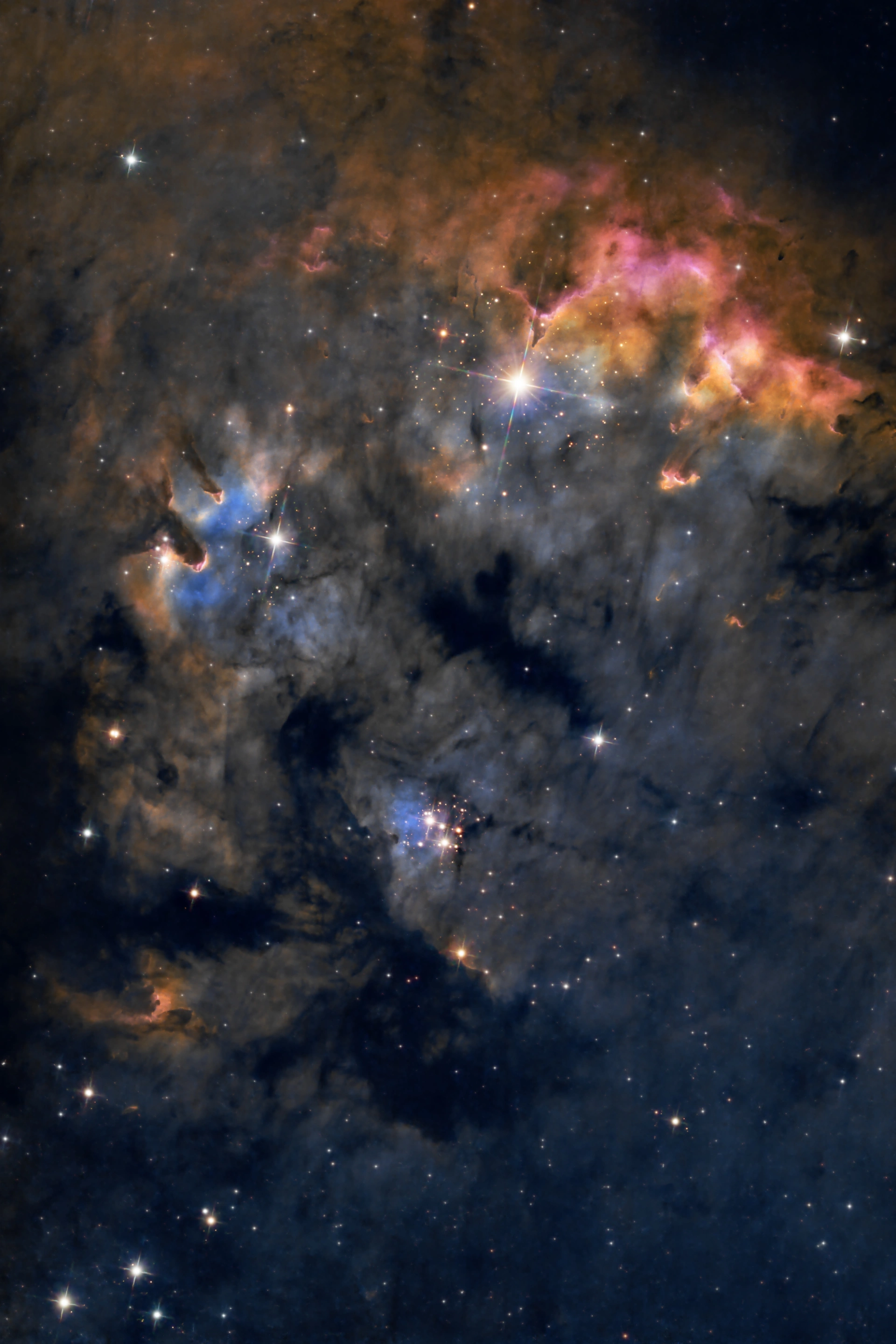
A spectacular display of nebula emissions and a small stellar nursery
We are once again in the constellation Cepheus, but this time with a somewhat different kind of nebula than last time — and a very different imaging technique. This is what is known as an emission nebula, meaning that it emits its own light, unlike NGC 7023, which passively reflected the light of a star.
The nebula is often referred to as the “Teddy Bear” Nebula, because some people see a face in it, with the two brightest stars forming the eyes. I don’t quite see it myself — but it certainly sounds more appealing than SH 2-171.
Just below the centre is a small, dense cluster of stars. With an estimated age of only a few million years — compared with the Sun’s 4 billion years — it is practically a little stellar nursery!
Capturing the image
I have taken advantage of the emission nature of this nebula by using narrowband imaging, capturing the intensity of the specific wavelengths emitted by sulphur, hydrogen, and oxygen. These exposures are then combined into a colour image, where the colours represent the distribution of the different elements. This is generally referred to as false-colour imaging, because the colours are my own choices rather than naturally occurring colours.
At the same time, I have taken images in normal colour in order to preserve the stars’ natural colours.